|
|
Last Modified on Jan 17, 2026
The complexity of property division in Texas divorce cases often adds more stress to the already complicated process of ending a marriage. Even in the most amicable divorce, splitting your assets and debts requires thorough financial documentation, tracing asset ownership, assessing property value, and other complex tasks. Understanding what the property division process in Texas entails and how a property division lawyer can help you is crucial during this time.
Understanding the Difference Between Separate and Community Property in Texas
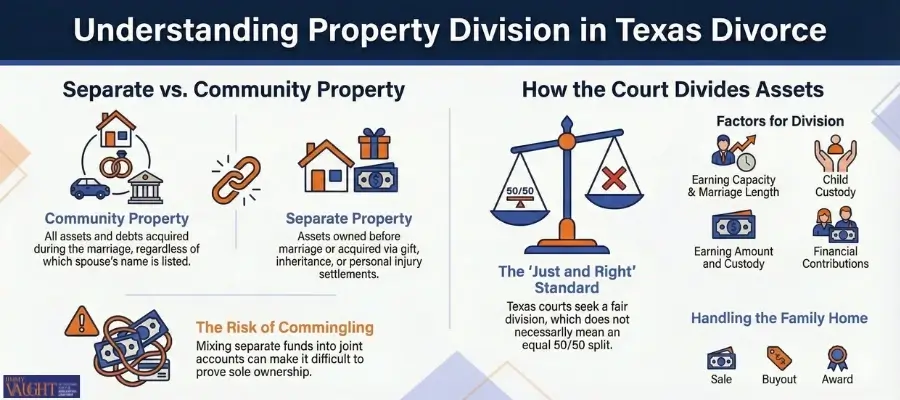
To understand how marital property is divided in Texas, you must first understand community property laws. Texas is a “community property state”, meaning that the state defines property as either marital property, which is also called “communal,” or separate property. Only communal assets can be divided during the property division process of a divorce. The following are the main differences between separate and marital property in Texas:
- Marital Property: In Texas, marital property includes all assets and debts that a couple collects while they are legally married. All marital property is considered communal, meaning both spouses share equal ownership rights over their assets. Even assets that are named under one spouse that were acquired during the marriage may be classified as marital property, such as cars, family homes, and individual incomes.
- Separate Property: Separate property in Texas covers most property one spouse acquires on their own before marriage. It also includes a few important exceptions to the community property rule. These exceptions include any property acquired as a gift, inheritance, or damages from a personal injury settlement. Even if acquired while the spouses are married, the court may classify these assets as separate.
What Is the Commingling of Assets in Texas?
Oftentimes, separate and community assets in Texas are entangled through a process called “commingling”. For example, if one spouse receives an inheritance and chooses to put the funds into their joint bank account, it may be more difficult to prove this property is separate if both spouses have been benefiting from it.
Separate and community ownership shares in commingled property can be traced through careful documentation. If you are concerned about untangling commingled property, you should hire a Texas property division lawyer who can protect your assets.
How Community Property Is Divided in a Texas Divorce
While most community property states generally require courts to split community property 50/50 in a divorce, Texas’s divorce laws are different. Per Texas Family Code Section 7.001, local courts must try to find a “just and right” division of property, which doesn’t necessarily entail an even split.
Courts consider many different factors when determining what counts as “just and right” division of property in Texas, including:
- Both spouses’ incomes and future earning capacity
- The length of the marriage
- The financial contributions of both spouses
- Who has custody of any children, and the needs of those children
- Who is at fault in the divorce (if relevant)
Hire a Property Division Lawyer in Texas
While Texas has a lower divorce rate than most states, sitting at around 2.1 divorces per 1,000 state residents, the state still commonly sees divorce and property division cases. If divorce is the next step in your life journey, you don’t have to take it alone. While dividing your marital property can be daunting, Jimmy Vaught of Counsel for the Eggleston Law Firm can provide you with the support, guidance, and resources you need to navigate your case confidently.
Mr. Vaught is a dedicated family attorney with over 35 years of experience in his field. He has earned numerous accolades recognizing his status as a leading family law practitioner, among them the honor of being one of only 1,600 attorneys in the US who qualify for the prestigious American Academy of Matrimonial Lawyers. He is also board-certified in family law by the Texas Board of Legal Specialization.
FAQs
How Do Prenuptial Agreements Impact Property Division in a Texas Divorce?
Prenuptial agreements often address how specific property should be divided in the event of a divorce. They can also distinguish all separate property each spouse has acquired before their marriage begins, making certain that they can prove their ownership later on. If you are concerned about how your agreement will affect your divorce or you’d like to create one that addresses property division, you should consult a divorce attorney.
How Is the Family Home Divided in a Texas Divorce?
If your house is community property, both spouses have equal ownership rights. Even if you purchased it before your marriage, your spouse may still claim ownership if they made significant contributions to it. Because a home cannot be physically split in half, courts will either require the home to be sold and profits to be split, give one spouse the home and another spouse equal assets, or have one spouse buy out the other spouse’s share.
How Can a Property Division Lawyer in Texas Help Me?
If you’re going through a divorce in Texas or are separating from your long-term partner, it’s imperative that you hire a property division lawyer who can help you understand your rights and protect the assets that rightfully belong to you.
While Texas legislation aims for a fair and just distribution of assets, spouses may try to hide or undervalue certain pieces of property and work to get an unfair share of assets. A lawyer can protect you against these practices and help secure a fair property division settlement on your behalf.
What Assets Are Untouchable in a Texas Divorce?
Any assets that are classified as separate property in Texas cannot be divided in a divorce. Your separate property can include inheritances, gifts from loved ones, personal injury settlements, and any property you solely owned before your marriage began. If you need to protect your separate assets, a Texas property division attorney can help protect your rights.
Dedicated Property Division Services in Texas
Navigating the property division process in Texas can be difficult, especially when disputes and high emotions are involved in your case. However, Jimmy Vaught of Counsel for the Eggleston Law Firm has the skills and knowledge needed to help Texas residents achieve property division settlements that help them feel confident moving forward.
To learn more about the trusted property division services at Jimmy Vaught of Counsel for the Eggleston Law Firm, contact the firm today to set up your initial consultation.